
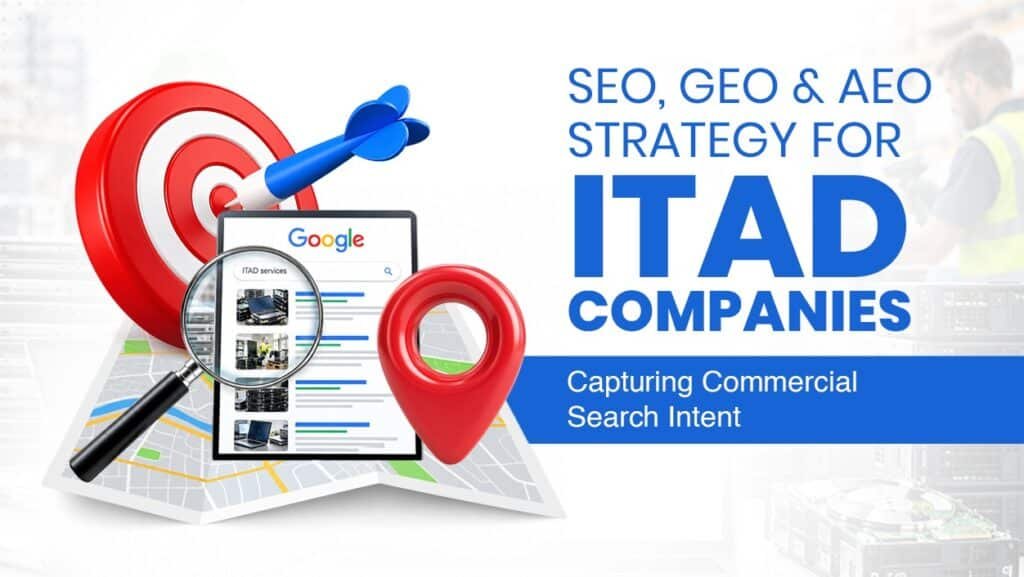
Search is becoming part of the buying process long before an ITAD provider receives an enquiry.
That process is also becoming harder to track. A procurement manager may search for ITAD providers. A security lead may investigate data sanitisation standards. An operations team may compare collection and chain-of-custody processes. Increasingly, some of that research is happening through generative AI.
Gartner reported in 2026 that 45% of surveyed B2B buyers had used GenAI during a recent purchase, primarily to research vendors and products. Buyers used an average of seven information sources during that purchase, showing that AI is becoming another layer in an already fragmented research journey.
For ITAD companies, this changes the search challenge. The objective is no longer simply to appear for “ITAD services”. The website needs to make the business understandable when a buyer, search engine or AI system is trying to establish what the company does, where it operates, what standards it follows and whether its claims can be trusted.
The ITAD Search Journey Is Broader Than “ITAD”
An enterprise buyer rarely researches an ITAD provider using one phrase.
The search journey can move from broad commercial terms such as “IT asset disposition company” to questions about ITAD Software Provider, secure data destruction, NIST SP 800-88, chain of custody, asset recovery, remarketing, electronics recycling or ITAD RFP requirements.
Each search reveals something different about the buying process.
A security team may want evidence that data-bearing devices are properly sanitised and verified. Procurement may need certifications, insurance, geographic coverage and reporting capabilities. Finance may be interested in residual value recovery. Sustainability teams may want to understand reuse, recycling and downstream processing.
That is why an ITAD SEO strategy built around a single keyword list will usually miss part of the commercial opportunity.
SEO: Build the Search Foundation Around Commercial Intent
Google’s current guidance is clear on one important point: existing SEO fundamentals remain relevant to AI search. AI Overviews and AI Mode rely on Google’s Search systems and indexed web content, and Google says there are no separate technical requirements or special optimisation techniques required for inclusion.
For an ITAD company, that means the fundamentals still matter.
Service pages need to be genuinely useful. Important content must be crawlable and available in text. Internal linking should establish relationships between services, industries, compliance topics and supporting resources. Technical problems should not prevent search engines from understanding the site.
The bigger issue is intent.
An ITAD website should cover the searches closest to commercial decisions, including services, asset types, industries, compliance requirements, data security, logistics and value recovery. It should also address the questions buyers ask before they are comfortable contacting a provider.
A page targeting “ITAD services” cannot realistically answer all of those questions well.
GEO: Give AI Systems Something Worth Citing
Generative search changes how information is consumed. Instead of presenting ten blue links, an AI system may combine information from several sources and produce a concise answer.
Google describes this process as using retrieval and grounding to surface relevant information from its Search index. OpenAI similarly allows public websites to be discovered and surfaced in ChatGPT Search when they permit its search crawler to access their content.
That creates a practical question for ITAD companies:
If an AI system is asked to recommend or explain an ITAD provider, is there enough useful information on the web for it to understand the business accurately?
“Secure IT asset disposal” tells the system very little.
A stronger body of content might explain the company’s collection process, asset identification, chain of custody, data sanitisation methodology, verification, reporting, remarketing process and downstream controls. Where relevant, it can reference recognised frameworks such as NIST SP 800-88, IEEE 2883, R2, e-Stewards or ADISA, alongside the technologies and processes actually used.
The detail matters because generic claims are easy to reproduce. Operational evidence is harder to substitute.
Bing’s AI Performance reporting now makes part of this visible. It shows which pages are cited in supported AI experiences, the grounding queries associated with those citations and changes in citation activity over time. Bing is careful to state that a citation does not represent ranking, authority or traffic.
That distinction matters. AI visibility is measurable, but it should not be confused with a new version of traditional rankings.
What Questions Should an ITAD Company Answer Online?
This is where AEO becomes useful.
The best questions are not manufactured simply because they contain a keyword. They come from the issues that can delay an ITAD decision.
For example:
How does an ITAD provider maintain chain of custody?
A useful answer should explain the actual control process, from collection and asset identification through transportation, processing and final disposition.
How is data sanitisation verified?
The answer can explain the methods used, the applicable standards, how failed erasures are handled and what evidence the customer receives.
What happens to equipment after data destruction?
The buyer may need to understand testing, grading, remarketing, reuse, recycling and reporting.
These questions can sit within service pages, dedicated resources, RFP guides, compliance content or FAQs. The format is less important than the quality of the answer.
Evidence Is What Separates ITAD Content From Generic Content
ITAD is a trust-sensitive purchase. Buyers are handing over equipment that may contain sensitive corporate information, commercially valuable hardware or assets subject to contractual and environmental obligations.
That makes evidence particularly important.
An ITAD company can say that it provides secure data destruction. A stronger website can explain the sanitisation process, identify the relevant standard or certification, describe verification and show what documentation the customer receives.
The same applies to asset recovery. “We maximise asset value” is a marketing statement. Explaining how equipment is assessed, graded, routed for remarketing or recycling, and reported back to the customer provides something a buyer can actually evaluate.
This is where experience becomes visible in content.
A page that understands serialisation, device-level reporting, sanitisation certificates, chain-of-custody records and downstream disposition will naturally provide more useful information than one built around repeated variations of “trusted ITAD provider”.
One Search Strategy, Applied Across Different Search Experiences
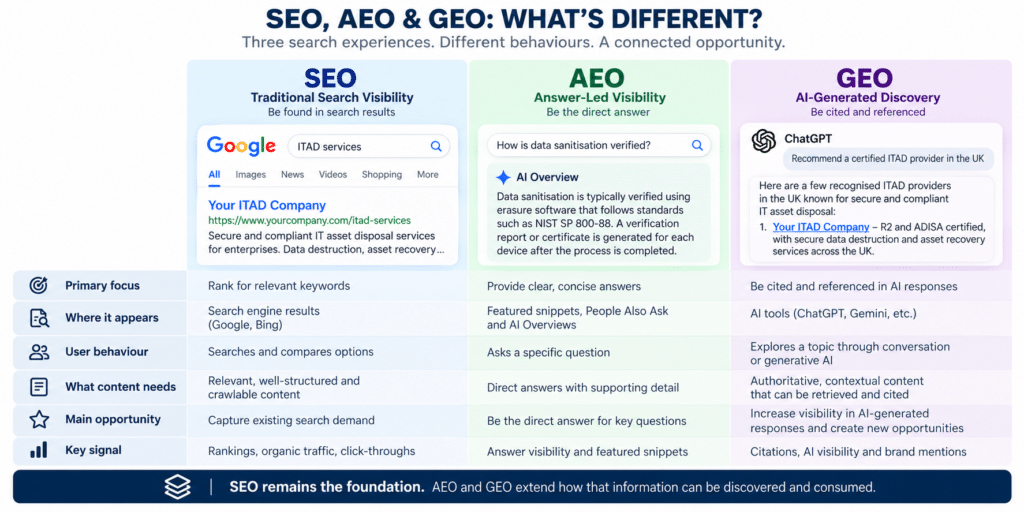
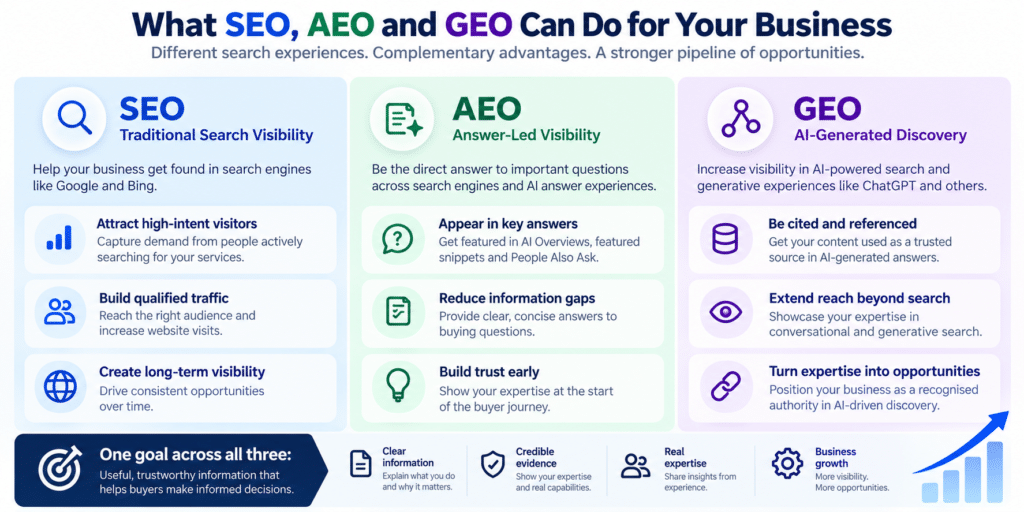
SEO, AEO and GEO should therefore be considered together.
SEO establishes discoverability through strong technical foundations, useful pages and relevant search intent.
AEO considers whether important buyer questions can be answered clearly and directly.
GEO considers whether the same information is sufficiently clear, specific and credible to be retrieved and referenced within generative experiences.
E-E-A-T runs through all three. It is demonstrated through evidence, expertise, accurate information, first-hand knowledge and clear ownership of claims.
The same ITAD content asset can support all of this.
Take data sanitisation. A strong page can target commercial searches around data destruction, answer questions about verification, explain relevant standards, document the process and provide evidence of the company’s capabilities. One useful resource can therefore support traditional search, answer-led discovery and AI retrieval without creating three separate pieces of content.
From Search Visibility to an ITAD Enquiry
Search visibility only becomes commercially useful when the next step is clear.
An ITAD buyer arriving from a search about data destruction may not be ready to request a full ITAD programme. They may first want to understand the process, check whether the provider covers their geography, confirm a certification or establish whether the company handles their asset volumes.
The conversion path should reflect that.
A useful ITAD journey might look like:
For example, someone searching for secure data destruction could land on a dedicated service page. That page should answer the immediate question, explain the sanitisation and verification process, reference relevant standards, and show what evidence the customer receives. The next action could then be a data destruction assessment, request for service scope or RFP discussion, rather than a generic “Contact Us” button.
The same principle applies to asset recovery. A buyer searching for IT asset remarketing may first need to understand how assets are assessed, graded, valued and routed for reuse or recycling. A stronger conversion path can move from that information to a residual value assessment or asset recovery consultation.
For enterprise ITAD, the conversion should also accommodate procurement-led journeys. An RFP resource, service capability document, sample reporting structure or compliance information can help a buyer validate the provider before speaking with sales.
This creates a more useful relationship between SEO and conversion. The page is not simply designed to attract traffic. It helps the buyer complete the next stage of their evaluation.
The goal is not to force every visitor into a sales enquiry. It is to give each high-intent visitor a credible next step based on where they are in the ITAD buying process.
A Practical Search Framework for ITAD Companies
A stronger ITAD search strategy can be built around six areas:
1. Start with the services you actually sell.
Map data destruction, collection, decommissioning, remarketing, recycling, asset recovery and other commercial services.
2. Map the questions surrounding each service.
Look at security, compliance, cost, logistics, turnaround, reporting, geography, asset types and procurement requirements.
3. Build evidence into the website.
Show relevant certifications, standards, methodologies, technologies, processes, case studies and customer-facing documentation.
4. Create content around genuine buying intent.
Prioritise pages that help a buyer understand, compare and evaluate the service rather than producing thin pages for every keyword variation.
5. Make the information easy for both people and machines to interpret.
Use clear headings, descriptive language, internal links, accessible text and structured information that accurately reflects what users can see on the page. Google continues to recommend these foundational practices for AI search.
6. Measure visibility beyond conventional rankings.
Track organic performance and qualified enquiries alongside emerging AI visibility signals, including cited pages and grounding queries where reliable data is available. Bing’s current reporting makes this possible for supported AI experiences.
Search Is Changing. The Information Buyers Need Is Not.
An ITAD buyer still needs to establish whether a provider can handle the assets, protect the data, control the process, recover value and provide defensible evidence.
What is changing is where that evaluation happens.
Some research will happen through Google. Some through an AI answer engine. Some through a supplier’s website, an RFP document or a conversation with sales.
The ITAD companies that benefit from this shift will be the ones with something useful to discover in the first place: specific expertise, clear answers, credible evidence and enough operational detail to withstand scrutiny.
That is the real role of SEO, GEO and AEO in ITAD. Not three disconnected optimisation exercises, but a search strategy that makes the business easier to find, understand and trust wherever the buyer begins the research.
Is Your ITAD Business Being Found by the Buyers You Want?
Assess where your search visibility stands across traditional search, answer engines and AI-powered discovery.