


Referrals can be one of the strongest sources of business for an ITAD company. They come with trust already attached, often shorten the sales process and can lead to valuable long-term accounts. The difficulty starts when referrals become the only dependable source of new business. If the next major contract depends on an existing customer making an introduction, a former contact moving into the right company, or someone in the network remembering your business at the right time, growth becomes difficult to plan. The answer is not to stop relying on relationships. It is to build additional routes into the market. For an ITAD company, that can mean being found when a buyer is searching, identifying organisations that fit the ideal customer profile, approaching them with relevant outreach, following up on genuine interest and giving sales a clear view of what is happening at every stage. The objective is not simply to generate more leads. It is to create a system in which search, prospecting, email, sales follow-up and CRM activity contribute to the same pipeline. Who is this article for? This article is for owners, CEOs, managing directors and commercial leaders of ITAD, e-waste, WEEE, electronics recycling, refurbishment and asset recovery businesses that want to reduce their dependence on referrals and build more deliberate routes to new customers. It is particularly relevant if the business has strong operational capability and an established reputation, but wants to reach larger accounts, enter new markets or make new-business generation more measurable. Key takeaways What makes a B2B pipeline predictable? Predictability does not mean knowing exactly how many contracts will close next month. B2B sales, particularly enterprise ITAD work, does not operate with that level of certainty. Projects move, procurement cycles change and buying decisions involve multiple people. A more useful definition is having enough control and visibility to understand where future opportunities are coming from and what needs to happen to create more of them. That starts with the market the company wants to reach. If an ITAD business wants to win more enterprise accounts, for example, it needs to identify the organisations that fit that objective. It then needs ways to become visible to those organisations, whether they are already looking for an ITAD provider or have not yet reached that point. From there, the business needs a process for turning interest into conversations, conversations into qualified opportunities and opportunities into proposals and contracts. That means several activities that are often treated separately need to work together: Pipeline activity Its role Inbound search Captures existing demand from buyers researching problems and suppliers Outbound prospecting Creates access to selected accounts that may not yet be searching Email campaigns Starts or develops conversations with relevant contacts Website and content Helps buyers evaluate the company before and during sales engagement Sales follow-up Converts interest into a commercially meaningful conversation CRM and reporting Shows what is happening and where opportunities are being lost The objective is not to make every channel produce leads independently. It is to make the channels work together around the accounts and opportunities the business actually wants. Start with the accounts you want to win Before increasing website traffic or sending more emails, an ITAD company needs to be clear about its target market. This sounds obvious, but it is where many pipeline programmes become too broad. A company may say it wants “more enterprise customers”, but that does not tell the sales or marketing team which organisations to pursue. The target account definition might consider: The purpose is not to create a perfect database. It is to create enough commercial focus that marketing and sales are working towards the same market. This also changes how performance should be viewed. If the company wants to win 50 specific enterprise accounts, generating thousands of visitors from unrelated businesses is not necessarily progress. Reaching and engaging the right organisations may be far more valuable than producing a larger overall audience. That is the starting point for a predictable pipeline. Inbound search: capture buyers already looking Inbound search is about being visible when a potential customer has a problem, project or requirement that leads them to search for information. An ITAD buyer may not begin with the words “find an ITAD company.” They may be researching: Those searches represent different forms of intent. Some indicate early research. Others suggest that a project is becoming more concrete. The job of the inbound strategy is not simply to rank for the largest possible number of keywords. It is to create useful visibility around the questions and problems that matter to the target customer. What needs to happen after the click? Search visibility on its own does not create a pipeline. The visitor needs to land on a website that quickly establishes: A useful search strategy therefore connects query → relevant page → useful information → commercial next step. That next step does not always need to be “contact sales.” For an early-stage researcher, it might be reading a detailed guide or understanding the company’s capabilities. For someone actively evaluating suppliers, it could be requesting a consultation, discussing a project or submitting an enquiry. The important point is that inbound should be designed around the buyer’s stage rather than treating every visitor as an immediate sales lead. Outbound prospecting: create access to accounts that are not searching Inbound captures existing demand. Outbound allows the company to create access to accounts it already knows it wants to win. This distinction is important for ITAD because a potentially valuable organisation may have no reason to search for an ITAD provider today. It may already have a supplier. It may have an internal process. It may simply not be thinking about asset disposition at the moment. That does not necessarily make the account irrelevant. The opportunity is to understand why that organisation might eventually need the service and whether there is a credible reason to begin a conversation. Potential triggers could include: The quality of outbound therefore depends heavily
Will AI Replace Human Grading and Device Testing in ITAD
It’s a question I’ve been asked several times over the past year. As AI becomes better at analysing images, detecting cosmetic defects, and automating hardware diagnostics, it’s natural to wonder whether the role of technicians will eventually disappear. Personally, I think we’re asking the wrong question. After working closely with ITAD businesses over the last few years, I’ve noticed that the businesses gaining the greatest advantage aren’t necessarily the ones adopting AI first. They’re the ones using technology to build better systems. The Shift from AI to Operational Intelligence AI can already improve consistency in grading, accelerate diagnostics, and reduce repetitive manual work. Those are significant operational benefits. But the real value isn’t that AI replaces people. It’s that it allows skilled teams to focus on decisions that genuinely require experience, commercial judgement, and technical expertise. The bigger transformation happening in ITAD isn’t AI. It’s operational intelligence. Enterprise customers now expect far more than secure data destruction and compliant recycling. They expect a complete chain of custody, faster turnaround times, real-time operational visibility, measurable environmental outcomes, and reporting they can confidently use for governance and ESG initiatives. As circular economy commitments and regulatory expectations continue to grow, these requirements are becoming part of everyday enterprise procurement. None of those expectations are solved by AI alone. They’re achieved when diagnostics, grading, inventory, compliance, reporting, finance, and customer communication are connected through a single operational workflow. AI Is Only as Powerful as the Systems Behind It This is where I believe businesses should be careful not to view AI as the destination. If disconnected spreadsheets and manual processes remain at the heart of the operation, introducing AI simply automates inefficiency. The businesses creating long-term competitive advantage are investing in connected systems where data flows seamlessly across the entire asset lifecycle, from collection and testing through to resale, compliance reporting, and environmental impact measurement. AI becomes another capability within that ecosystem, not the ecosystem itself. In my view, the future of ITAD won’t be won by the businesses that adopt AI first. It will be won by those that connect people, processes, systems, and data better than everyone else. Operational Excellence Isn’t Enough Anymore There’s another shift that’s just as important. Operational excellence has little commercial value if the market can’t see it. Today’s enterprise buyers evaluate potential ITAD partners long before the first conversation takes place. They review websites, technical content, sustainability commitments, compliance credentials, and increasingly discover suppliers through AI-powered search experiences that prioritise authoritative, well-structured information. I’ve seen businesses with exceptional operational capabilities lose visibility simply because their digital presence doesn’t reflect the expertise they’ve built internally. Operational intelligence and digital authority now go hand in hand. Building intelligent internal operations is only part of the equation. Businesses also need to communicate that capability clearly to the market. The organisations that make their expertise visible, credible, and easy to validate will be better positioned to win trust before a conversation even begins. Where the Industry Is Heading So, will AI replace human grading and device testing? I don’t believe so. But it will redefine where people create the most value. The businesses that lead the next generation of ITAD won’t be those choosing between people and AI. They’ll be the ones combining experienced teams, connected systems, and digital authority to build organisations that are not only operationally excellent, but impossible to overlook. At Retentia Eco Impact, these are the conversations we’re increasingly having with ITAD and circular economy businesses as they navigate the next phase of industry growth. I’d be interested to hear how others in the industry see AI, automation, and connected systems shaping the future of ITAD. Originally published by Praveena Sasidharan, Founder of Retentia Group, on LinkedIn. You can read the original article here

Why Your ITAD Business Isn’t Winning Enough Enterprise Contracts
Your ITAD business may be capable of handling enterprise accounts, but that doesn’t necessarily mean enterprise buyers see you that way. You may have secure data destruction, asset tracking, remarketing, recycling, logistics and compliance processes in place. You may even have years of experience handling large volumes of retired technology. Yet when an enterprise starts comparing providers, your company may not make the shortlist. The problem may be less about what you can deliver and more about what buyers can discover, understand and verify about your business before they contact you. Enterprise ITAD procurement rarely begins with “find an ITAD company.” The process often starts much earlier, with questions around data sanitisation, asset recovery, chain of custody, compliance, sustainability and the operational complexity of disposing of technology at scale. If your website only tells buyers what services you offer, you are missing a large part of that journey. The ITAD Website Problem: Service List vs. Buying Decision Consider two ITAD landing pages. The first says: Enterprise IT Asset Disposition ServicesSecure IT asset disposal, data destruction, recycling and remarketing.Contact us for a quote. There is nothing technically wrong with it. But an enterprise buyer still doesn’t know much about the provider’s ability to manage a complex programme. Now consider a page built around an actual enterprise requirement: Secure IT Asset Disposition for Multi-Location Technology Refreshes Retiring 5,000 laptops across 20 locations involves more than collection. Our process maintains asset-level tracking from collection through data sanitisation, remarketing or responsible recycling, with documented chain of custody and reporting throughout the programme. The second page immediately gives the buyer more to evaluate. It speaks to scale, complexity, process, security and visibility rather than simply listing services. That difference matters because enterprise buyers aren’t looking for a catalogue of ITAD business services. They are trying to determine whether a provider can safely and reliably manage their particular requirements. Your landing pages should therefore answer questions such as: The more clearly your website answers these questions, the less work the buyer has to do to establish your credibility. Enterprise Buyers Research the Problem Before They Research You This is where many ITAD companies underestimate the role of SEO. A security professional may not initially search for an ITAD provider. They may search for NIST SP 800-88 data sanitisation requirements because their organisation is reviewing its media disposal process. An IT operations team might search for enterprise IT asset disposition best practices while planning a hardware refresh. A procurement team might investigate how to maximise value from retired IT equipment before evaluating remarketing providers. A sustainability team may research responsible electronics recycling and IT asset disposition as part of its environmental reporting requirements. These searches have something in common: the buyer is looking for an answer before looking for a supplier. This is the opportunity. An ITAD company that publishes authoritative content around these questions can become visible much earlier in the buying journey. The content isn’t simply there to generate an immediate enquiry. It establishes expertise at the point when the buyer is forming an understanding of the problem. This is also where AEO and GEO become increasingly relevant. When users ask detailed questions through Google, AI search experiences or generative platforms, concise, authoritative answers are more likely to become part of the information they encounter. For an ITAD business, that means building content around real questions rather than producing articles simply because they contain the phrase “ITAD services.” A useful guide to NIST SP 800-88, for example, can attract a security-focused audience. A detailed explanation of ITAD chain of custody can reach IT and compliance teams. A practical guide to IT asset remarketing can introduce your expertise to procurement and finance stakeholders. The goal is to build topical authority around the issues that lead organisations to need ITAD in the first place. Your Enterprise Proposition Needs More Than “Secure, Compliant and Sustainable” Most ITAD providers can make similar claims. Secure.Compliant.Sustainable.End-to-end. The problem isn’t that these statements are wrong. It’s that they don’t differentiate your business unless you demonstrate what they actually mean in practice. Take data destruction. “Secure data destruction” is a service claim. A stronger proposition might explain that every data-bearing asset is tracked through the disposition process, processed according to the applicable sanitisation requirements, and supported by documentation that gives the customer evidence of completion. The same principle applies to asset recovery. “Remarketing services” tells the buyer what you do. A stronger proposition explains how assets are assessed, valued, channelled into appropriate resale markets and reported back to the customer, with recovered value helping offset the cost of technology refresh programmes. The distinction is important: A service describes what you do. A business outcome explains why the customer should care. Enterprise buyers need both. Proof Is What Turns Capability Into Confidence This is where many otherwise capable ITAD businesses leave money on the table. A website may claim to handle enterprise volumes, but where is the evidence? A provider may say it offers secure chain-of-custody management, but can a buyer understand how that process works? A company may promote sustainability, but can it demonstrate what happens to assets that cannot be remarketed? This is why enterprise-focused ITAD marketing needs evidence alongside claims. A strong case study, for example, shouldn’t simply say: “We processed 10,000 devices for a global customer.” It should explain the challenge: perhaps the organisation was replacing thousands of devices across multiple locations and needed secure collection, data sanitisation, asset tracking and value recovery without disrupting operations. Then show how the programme was managed and what resulted from it. That could include processing volume, turnaround time, percentage of assets remarketed, value recovered, data destruction documentation or environmental reporting, where those figures can be disclosed. Suddenly, the buyer isn’t reading a marketing claim. They’re seeing evidence of how the provider operates. For enterprise contracts, that distinction can be decisive because the perceived risk of choosing the wrong provider is much higher. Don’t Wait for the RFP to Start Selling By the
Why the Future of ITAD Belongs to Value Recovery Companies
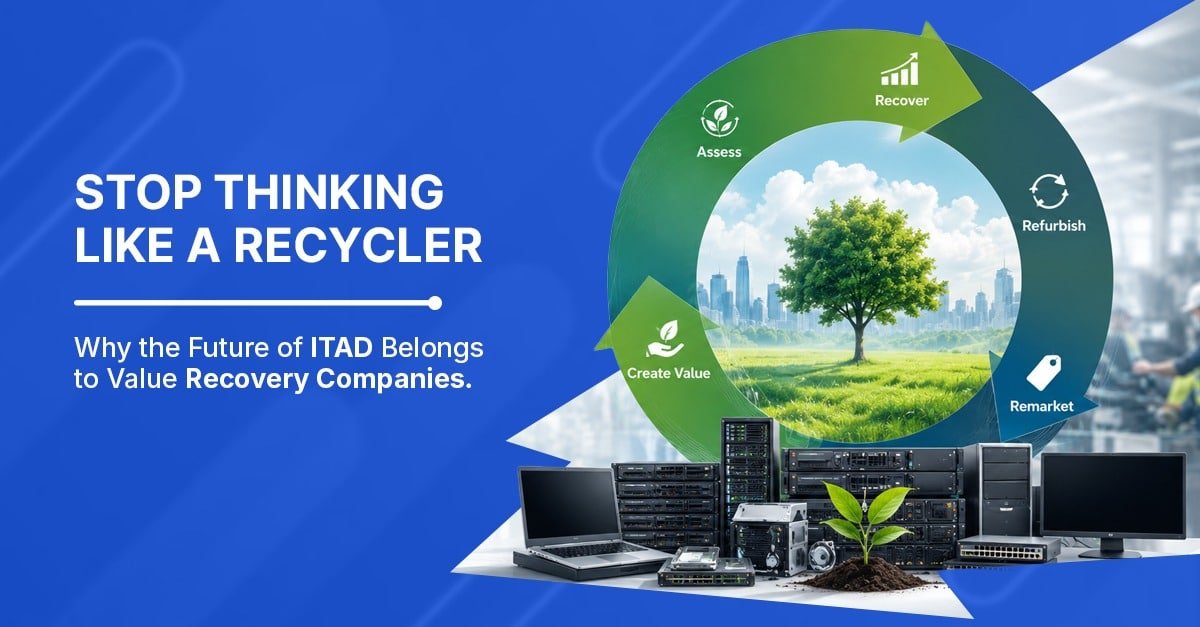
The ITAD industry has a major positioning problem. Many providers have invested heavily in serialisation tracking, software data erasure, global remarketing networks and workflow automation. Yet much of the industry’s marketing still revolves around trucks, pallets and industrial shredders. The market’s expectations have evolved. As the ITAD market continues to expand globally, enterprise buyers are no longer looking for a vendor to simply haul away and destroy retired hardware. They are comparing providers based on business outcomes: capital recovery, risk reduction, audit-ready ESG reporting and data asset intelligence. If you continue marketing your business as a commodity recycler, you will continue to be compared strictly on disposal costs. Here is why the future of ITAD belongs to Value Recovery Companies: Why the Future of ITAD Belongs to Value Recovery Companies For too long, the IT Asset Disposition (ITAD) industry has described itself in narrow, industrial terms: Collect the equipment, wipe the data, recycle what remains, issue a disposal certificate and move on. That model still matters. Secure data sanitisation, compliant disposal and responsible recycling remain fundamental operational baselines. The challenge is that this traditional narrative no longer reflects how enterprise buyers think about retired technology. Today, laptops, servers, networking equipment, storage arrays, processors and memory modules are not simply electronics waiting to be discarded. They are financial instruments, compliance obligations and core sustainability opportunities. The centre of gravity in the market is shifting from disposal to Value Recovery. As that structural shift accelerates, ITAD companies that continue positioning themselves primarily as recyclers risk sounding increasingly commoditised in an enterprise market that has become highly strategic. The Capital Catalyst: 2026’s Perfect Storm The pressure on enterprise technology estates has reached a tipping point. The end of standard support for Windows 10 has accelerated a major enterprise refresh cycle, forcing many organisations to reassess device replacement, redeployment and lifecycle management strategies. Simultaneously, enterprises are navigating two additional pressures. Growing investment in AI infrastructure is accelerating refresh decisions across segments of enterprise technology, increasing the volume of assets entering secondary markets. At the same time, ongoing supply chain volatility and semiconductor constraints continue to place pressure on hardware procurement budgets. For a CIO, retired assets represent an immediate governance and security challenge. For a sustainability leader, they represent a critical avenue to meet Scope 3 value-chain emission requirements. But for a CFO, they represent something equally vital: recoverable capital. A room filled with decommissioned laptops or retired server racks is no longer viewed simply as electronic waste. Many retired enterprise assets retain residual value through refurbishment, component harvesting, redeployment or secondary-market remarketing. A basic recycler sees scrap weight and charges a disposal fee a Value Recovery Partner focuses on maximising residual value and returning recoverable capital back into the technology budget. Moving Beyond the Shredder: What Enterprises Actually Buy This is precisely why the language of traditional “recycling” has become too small for what elite ITAD providers actually deliver. While materials reclamation is a vital downstream outcome, leading with the physical shredder often overshadows the broader business value being created. Modern enterprise buyers are not looking to purchase a logistics or disposal service. They are buying specific business outcomes: When an ITAD firm realigns its positioning around right-column outcomes, it shifts away from procurement-led price discussions and creates a stronger commercial conversation built around value, governance and measurable business impact. The Six Pillars of the Value Recovery Framework True Value Recovery is an integrated technology ecosystem. To capture enterprise market share, a provider’s positioning must clearly demonstrate maturity across six distinct operational pillars: The Future of the Category is Tech-Led, Not Truck-Led If you want a glimpse into the future of the industry, look beyond the warehouse floor. Look at the software. Leading ITAD providers are investing heavily in automated API integrations with corporate ITAM systems, automated chain-of-custody documentation and real-time valuation dashboards. They are scaling up programmatic sanitisation workflows because they recognise that the modern enterprise demands digital visibility. In every meaningful respect, the future ITAD provider will look as much like a technology company as a recycling company. This creates a critical commercial challenge for industry CEOs. Many ITAD providers have evolved significantly behind the scenes. Operationally, they are highly sophisticated. Yet strategically, their marketing remains stuck in the past, leading with photos of pallets, boxes and freight trucks. When you market your business like a recycler, the market treats you like a vendor. But when you lead with capital recovery, lifecycle intelligence and risk mitigation, the discussion shifts from warehouse managers to CIOs, CFOs, Chief Sustainability Officers and other executive stakeholders. The greatest opportunity in ITAD today is not operational innovation. Much of that innovation has already happened. The opportunity lies in how providers position, communicate and commercialise those capabilities in a market that increasingly values intelligence, transparency, governance and financial return. The next generation of ITAD leaders will not be defined by how many tons of scrap metal they process. They will be defined by how much corporate risk they remove, how much capital they recover and how effectively they secure the modern technology lifecycle. The providers that recognise this shift early will not simply participate in the future of ITAD. They will help define it. Find Where You’re Losing High-Value Opportunities The gap between operational capability and market perception is often where enterprise opportunities are won and lost. Many ITAD providers have evolved into sophisticated technology businesses, but their websites, messaging and digital presence still position them as traditional recyclers. Discover how strategic positioning, SEO and digital marketing built specifically for the ITAD industry can help your business attract enterprise buyers, strengthen market credibility and compete on value rather than price. Explore Our ITAD Digital Marketing Services → Shedule a free consultation Originally published by Praveena Sasidharan, Founder of Retentia Technology, on LinkedIn. You can read the original article here.

How AI Will Transform ITAD Businesses Over the Next Five Years
For decades, the IT Asset Disposition (ITAD) industry has been built on operational excellence. Providers invested in secure logistics, certified data destruction, compliant recycling, asset recovery, remarketing and environmental responsibility to meet the growing demands of enterprise organisations. These capabilities became the foundation of trust, helping businesses demonstrate compliance while protecting customers from data security and regulatory risks. But the market has changed. Today, enterprise buyers assume these capabilities already exist. Secure data destruction, WEEE compliance, asset reporting, chain of custody documentation and reverse logistics are no longer viewed as competitive advantages. They are considered the minimum standard expected from any credible ITAD provider. That shift is creating a new challenge. If operational capability is no longer enough to differentiate your business, what will? The answer lies in how efficiently your organisation operates, how intelligently it uses data and how effectively it communicates its value to enterprise buyers. Enterprise Buying Has Changed One of the biggest changes affecting the ITAD industry has little to do with technology itself. It is the way enterprise organisations buy. The buying journey rarely begins with a conversation. Long before procurement teams request proposals or schedule meetings, they are already researching potential partners. They evaluate websites, review certifications, compare service capabilities, assess customer credibility and look for evidence that a provider can support complex operational requirements. This means your business is often being evaluated before your sales team even knows an opportunity exists. At the same time, enterprise expectations continue to rise. Customers increasingly expect real-time reporting, faster turnaround times, complete asset visibility, detailed audit trails and sustainability data that supports their own environmental commitments. They are comparing every supplier against the digital experiences they receive from logistics providers, cloud platforms and enterprise software vendors. In other words, ITAD businesses are no longer competing solely against other ITAD providers. They are competing against a broader standard of operational transparency and customer experience. Why This Matters More Than Ever Margins across the industry continue to face pressure. Labour costs are rising. Compliance requirements continue to evolve. Customers expect more reporting without expecting significantly higher prices. At the same time, competition has increased as more providers offer similar core services. For many businesses, improving profitability is no longer about processing more assets. It is about removing operational friction. Every manual spreadsheet, duplicated task, delayed report and disconnected system adds unnecessary cost while slowing down customer service. The businesses that thrive over the next five years are unlikely to be those with the largest facilities or the biggest teams. They will be the organisations that make better decisions, respond faster and use technology to improve both operational performance and customer experience. AI Is Not the Story. Business Transformation Is. Artificial Intelligence has become one of the most talked-about technologies across every industry. Yet many discussions focus on the technology itself rather than the business outcomes it can deliver. For ITAD businesses, AI should not be viewed as a replacement for experienced engineers, compliance specialists or operations teams. Those professionals remain critical to ensuring secure data destruction, regulatory compliance and high-quality customer service. The real opportunity lies elsewhere. AI has the potential to remove repetitive manual work, improve operational visibility, support faster decision-making and enable teams to focus on higher-value activities that strengthen customer relationships and commercial growth. In other words, AI is not replacing expertise. It is amplifying it. That distinction is important because the businesses that gain the greatest value from AI will not necessarily be those investing in the most advanced technology. They will be the organisations that understand where technology can improve efficiency, strengthen decision-making and create a better experience for their customers. Where AI Will Create the Biggest Impact Across ITAD Businesses Artificial Intelligence is often associated with chatbots and content generation, but its greatest impact on the ITAD industry will be far less visible. The real value of AI lies in helping businesses make faster, better-informed decisions while reducing the manual effort that slows operations and affects profitability. ITAD providers generate vast amounts of operational data every day, from asset inventories and collection schedules to erasure certificates, resale values, logistics records and customer reports. Much of this information already exists within ERP systems, spreadsheets and operational platforms. The challenge is not collecting data. It is using it effectively. Businesses that transform this data into actionable intelligence will be better positioned to improve efficiency, strengthen customer relationships and compete for larger enterprise opportunities. 1. Smarter Asset Intelligence Every incoming asset presents a series of decisions. Today, many of these decisions rely on experience, manual assessment and historical knowledge. AI has the potential to analyse equipment specifications, condition, historical resale performance and current market demand to support faster and more consistent decision-making. Rather than replacing experienced technicians, AI provides another layer of intelligence that helps maximise recovery value while improving consistency across operations. 2. Better Pricing and Remarketing Decisions Asset values rarely remain static. Demand for refurbished laptops, networking equipment, servers and mobile devices changes constantly based on market conditions, product releases and supply chain trends. Traditionally, pricing decisions have relied on historical knowledge and market experience. AI introduces predictive analytics into the process. By analysing historical sales, inventory turnover and changing market demand, businesses can make more informed decisions about refurbishment, resale pricing and inventory holding periods. The result is improved recovery value and reduced time spent managing ageing inventory. 3. Compliance Reporting at Enterprise Speed Reporting has become one of the most valuable services ITAD providers deliver. Enterprise customers increasingly expect detailed asset inventories, certificates of data destruction, chain of custody documentation, environmental reporting and audit-ready records. Producing these reports manually consumes valuable operational time. AI can help validate information, identify missing records, automate document generation and reduce administrative effort without compromising accuracy. For customers, this means faster reporting and improved confidence. For providers, it creates operational efficiencies that can be reinvested elsewhere in the business. 4. Smarter Reverse Logistics Collection planning has always been one of the more complex operational challenges

How to Create a Content Marketing Plan That Actually Drives Results
Many organizations are producing more content than ever before. Blog posts are published regularly, webinars are hosted every month, and LinkedIn feeds are filled with thought-leadership posts. Yet despite this activity, a common question still surfaces inside marketing teams: “Why isn’t our content driving measurable business impact?” The issue usually isn’t effort. It’s the absence of a structured plan that connects content directly to business outcomes. Without a clear framework, content production becomes reactive. Teams publish pieces when they have time or when a campaign demands it. Over time, the library grows but the strategy remains fragmented. A well-designed content marketing plan changes that dynamic. Instead of creating isolated assets, the organization builds a coordinated system where content supports awareness, education, and decision-making across the entire buyer journey. Today that system is also being reshaped by AI-driven search experiences and new discovery platforms. Tools such as Google Search Generative Experience and Perplexity AI increasingly summarize information directly for users. As a result, content strategies must focus less on volume and more on authority, clarity, and relevance. The following framework outlines how organizations can build a content marketing plan that produces consistent, measurable results. Start With Clear Business Objectives Every effective content strategy begins with a clear understanding of what the organization wants to achieve. Content should never exist simply to “stay active.” It should support specific outcomes tied to growth, visibility, or customer engagement. Common objectives include: These goals should also be measurable. Instead of stating “increase website traffic,” define the result more precisely. For example: Generate 30 qualified demo requests per quarter from organic search traffic related to ERP modernization. This level of clarity ensures that every topic, asset, and campaign supports a defined business objective. AI analytics platforms are also making this step easier. By analyzing historical performance data and search patterns, they can identify opportunities where content is most likely to influence pipeline growth. Understand Your Audience and Their Buying Journey Once objectives are defined, the next step is understanding who the content is meant to help. Effective content marketing is grounded in real customer questions and challenges. This requires more than basic demographic information. Organizations need a clear picture of how their audience evaluates problems and solutions. A typical persona profile might include: Just as important is understanding how these individuals progress through the buying journey. Most B2B buyers move through three stages: Awareness Stage At this stage, the audience is trying to understand a problem. Typical search queries might look like: Content that works well here includes educational articles, guides, and industry insights. Consideration Stage Once the problem is defined, buyers begin exploring possible approaches. They may search for: Content formats often include: Decision Stage At this stage the audience is evaluating specific vendors or approaches. They need evidence that a solution works. Effective content here includes: A strong content marketing plan ensures that each stage of this journey is supported, rather than focusing only on top-of-funnel awareness. Build an SEO-Driven Topic Strategy Search remains one of the most reliable indicators of what audiences want to learn. When someone searches for a topic, they are revealing the language they use to describe their problem. This makes SEO research one of the most valuable inputs for content planning. However, modern SEO is not about publishing dozens of isolated keyword-focused articles. Search engines increasingly prioritize websites that demonstrate topic authority. This is why many organizations now structure their content around topic clusters. Instead of individual posts, they build collections of related articles centered around a core subject. Example: ERP Modernization Content Cluster A technology consulting firm might choose ERP modernization as a pillar topic. Supporting articles could include: Each article addresses a specific question while linking back to a central pillar guide. This structure benefits both readers and search engines. Readers can explore the topic in depth, while search algorithms recognize that the site demonstrates expertise across multiple related questions. AI-driven SEO tools now accelerate this process by identifying emerging search patterns and highlighting content gaps within competitor ecosystems. Use AI to Enhance Strategy and Execution Artificial intelligence is rapidly becoming embedded across the entire content lifecycle. However, its most valuable role is not replacing writers or strategists. Instead, it acts as an intelligence layer that improves planning and optimization. Several practical applications are already transforming how teams operate. Predictive Topic Discovery AI platforms can analyze search trends and industry discussions to identify emerging topics before they become highly competitive. This allows teams to publish authoritative resources early. Content Brief Automation Instead of manually researching every article, AI tools can assemble structured briefs including: Writers can then focus on producing deeper insight rather than repetitive research. Personalization at Scale AI can analyze user behavior and recommend content dynamically. For example, a visitor reading about ERP implementation risks might automatically receive suggestions for case studies or ROI analysis. This creates a more relevant content experience for each visitor. Performance Forecasting AI-driven analytics can also predict which topics are likely to generate traffic or conversions based on historical patterns. This helps marketing teams prioritize resources more effectively. Build a Realistic Content Calendar Even the best strategy will fail without consistent execution. A content calendar translates strategic priorities into a practical publishing plan. A typical calendar includes: For many B2B organizations, a sustainable cadence might look like: Consistency matters far more than raw publishing volume. A steady flow of well-researched articles will outperform a burst of rushed content followed by long gaps. Plan Distribution and Repurposing Publishing a piece of content does not guarantee that anyone will see it. A successful content marketing plan includes distribution and repurposing from the beginning. A single article can often support multiple formats and channels. For example, a long-form guide might also become: Repurposing extends the lifespan of each asset while reinforcing key messaging across channels. Measure Performance and Refine the Strategy Finally, a content marketing plan must include clear performance metrics. Common indicators include: Visibility Metrics Engagement Metrics Business Impact Metrics Regular
Top SEO Mistakes Manufacturing Companies Make (And How to Fix Them)
Manufacturing companies rarely fail at SEO because of one single error. Instead, they bleed visibility and RFQs through a series of avoidable mistakes. Many industrial websites still function as digital brochures, PDF-heavy, jargon-laden and organized around internal language rather than how engineers or procurement teams actually search. In 2026, this problem will be magnified by AI-powered search engines like Gemini, SearchGPT and Perplexity. Buyers increasingly begin research through these tools, asking precise questions about capabilities, tolerances and lead times. If your content isn’t structured for both humans and AI, your pages risk being invisible even if they rank in traditional search. Mistake 1: Targeting the Wrong Keywords Many manufacturers chase broad phrases like “manufacturing” or “metal fabrication.” While these have high search volumes, they rarely align with qualified buyer intent. The result: traffic without RFQs. High-intent searches usually reference material, process, industry, or compliance. For instance: Fix: Build keyword clusters around real buyer language: capabilities, materials, applications and standards. Map these to page titles, H1s, body copy and internal links. Focus on long-tail queries that reflect the full problem-to-solution journey. Mistake 2: Treating the Website Like a Brochure (Updated – Interactive Edge) Many manufacturers lead with static pages: history, mission statements, or generic copy. Thin pages, duplicated spec sheets and PDF-only content fail to answer buyer questions and rank poorly in both search and AI discovery. Fix: Treat every key page as a problem-solving asset. For each product or service: This approach improves rankings and gives sales teams strong, shareable URLs. Mistake 3: Ignoring Technical SEO and Visual Search Manufacturing sites often struggle with slow-loading pages due to large images or CAD files, complex navigation and PDF-bound content. AI crawlers prefer HTML pages with structured data. Fix: Mistake 4: Weak On-Page SEO Even good content underperforms if on-page fundamentals are missing. Common errors: model numbers in titles without descriptors, multiple H1s, missing meta descriptions, or headings that don’t reflect buyer intent. Fix: Mistake 5: Writing Only for Engineers (or Only Marketing) Technical content overloaded with specifications can alienate procurement or executives, while purely marketing copy may fail to convince engineers. Fix: Balance both: This ensures content appeals to all buyer personas and maps to long-tail searches. Mistake 6: Overlooking Local and Regional SEO (Updated – Hyper-Local Logistics) When building location or plant pages, don’t just list city names. Highlight logistics advantages and proximity to major hubs: This boosts visibility for geo-specific, high-intent queries and appeals to procurement teams searching for convenience and reliability. Mistake 7: Publishing Content Without Conversion Paths (Updated – Instant CAD Upload) Beyond standard CTAs, add file upload portals for engineers: This aligns content with top-tier 2026 buyer behavior, where engineers expect immediate, actionable interactions rather than filling generic contact forms. Mistake 8: Ignoring Schema and Zero-Click Intent Structured data is critical for both search engines and AI tools. Buyers increasingly expect direct answers for lead times, MOQ and starting prices without clicking through. Fix: Mistake 9: Neglecting EEAT and Generative Engine Optimization (GEO) Google’s 2025–26 updates reward first-hand experience. Pages authored or reviewed by engineers, with clear, data-backed tables, gain higher trust signals for AI engines. Fix: Mistake 10: Ignoring AI-Powered Search Engines Traditional SEO alone isn’t enough. AI tools like Gemini, SearchGPT and Perplexity are now discovery platforms themselves. Pages must provide clear, scannable answers that AI can parse. Fix: Quick Reference: Manufacturing SEO 2026 The Mistake 2026 Impact Quick Win Fix PDF-only specs Invisible to AI & mobile Convert to interactive HTML tables Jargon-heavy headlines Low CTR Use “Problem + Solution” headlines No video proof High bounce Embed 15-second machine/process videos Missing local signals Lost regional RFQs Dedicated “Service Area” pages + Logistics info Weak schema Zero-click missed Add Product Availability + Price schema No EEAT / GEO Poor AI visibility Tables & content reviewed by engineers Static content Low engagement Interactive calculators & instant CAD uploads Turning SEO Mistakes into Advantage In industrial markets, winning SEO is about disciplined execution. Correcting these mistakes allows companies to: Ignoring these issues allows competitors to quietly capture leads. Addressing them transforms SEO from a passive brochure into a consistent RFQ and revenue engine. The Role of a Digital Marketing Company in Manufacturing Visibility A specialized digital marketing company doesn’t just “do SEO.” In industrial and manufacturing contexts, their role is to: How We Help Manufacturing Companies Be Found With extensive experience in manufacturing, ERP and CRM, we implement technologies and strategies that address visibility and security gaps. We design and execute digital marketing plans that ensure manufacturing businesses are easily found when teams search for the specific services they offer.