

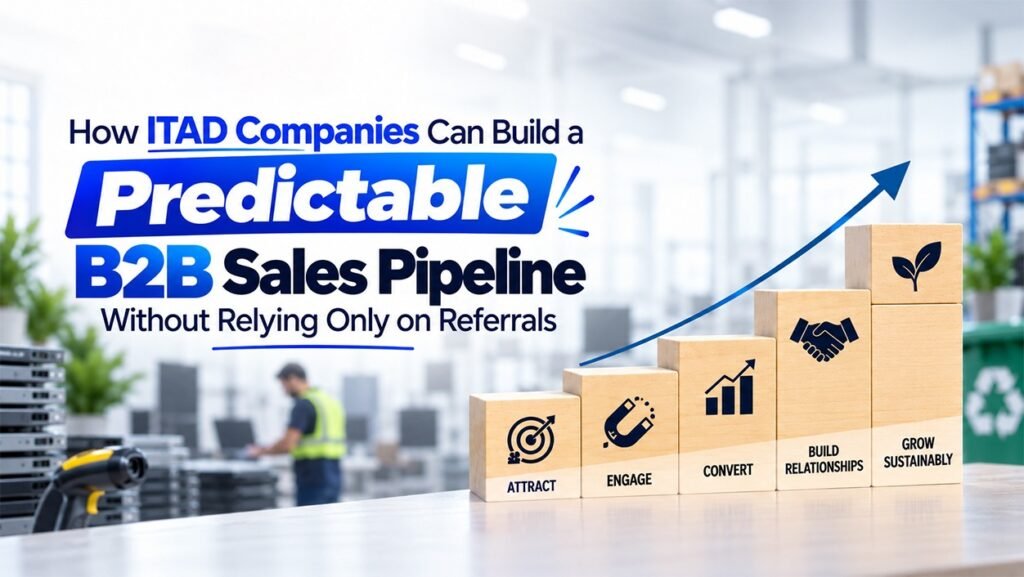
Referrals can be one of the strongest sources of business for an ITAD company. They come with trust already attached, often shorten the sales process and can lead to valuable long-term accounts.
The difficulty starts when referrals become the only dependable source of new business.
If the next major contract depends on an existing customer making an introduction, a former contact moving into the right company, or someone in the network remembering your business at the right time, growth becomes difficult to plan.
The answer is not to stop relying on relationships. It is to build additional routes into the market.
For an ITAD company, that can mean being found when a buyer is searching, identifying organisations that fit the ideal customer profile, approaching them with relevant outreach, following up on genuine interest and giving sales a clear view of what is happening at every stage.
The objective is not simply to generate more leads.
It is to create a system in which search, prospecting, email, sales follow-up and CRM activity contribute to the same pipeline.
Who is this article for?
This article is for owners, CEOs, managing directors and commercial leaders of ITAD, e-waste, WEEE, electronics recycling, refurbishment and asset recovery businesses that want to reduce their dependence on referrals and build more deliberate routes to new customers.
It is particularly relevant if the business has strong operational capability and an established reputation, but wants to reach larger accounts, enter new markets or make new-business generation more measurable.
Key takeaways
- Referrals can remain valuable without carrying the entire responsibility for new business.
- Inbound search helps capture buyers who are already researching a problem or supplier.
- Outbound prospecting creates access to target accounts that may not yet be actively searching.
- Email works best as part of an account-based outreach process, not as a volume exercise.
- Sales follow-up should add context and help buyers make decisions rather than simply repeat marketing messages.
- Website content increasingly needs to support both independent buyer research and AI-assisted discovery.
- CRM and reporting should connect marketing activity to qualified opportunities, proposals and revenue.
What makes a B2B pipeline predictable?
Predictability does not mean knowing exactly how many contracts will close next month.
B2B sales, particularly enterprise ITAD work, does not operate with that level of certainty. Projects move, procurement cycles change and buying decisions involve multiple people.
A more useful definition is having enough control and visibility to understand where future opportunities are coming from and what needs to happen to create more of them.
That starts with the market the company wants to reach.
If an ITAD business wants to win more enterprise accounts, for example, it needs to identify the organisations that fit that objective. It then needs ways to become visible to those organisations, whether they are already looking for an ITAD provider or have not yet reached that point.
From there, the business needs a process for turning interest into conversations, conversations into qualified opportunities and opportunities into proposals and contracts.
That means several activities that are often treated separately need to work together:
| Pipeline activity | Its role |
| Inbound search | Captures existing demand from buyers researching problems and suppliers |
| Outbound prospecting | Creates access to selected accounts that may not yet be searching |
| Email campaigns | Starts or develops conversations with relevant contacts |
| Website and content | Helps buyers evaluate the company before and during sales engagement |
| Sales follow-up | Converts interest into a commercially meaningful conversation |
| CRM and reporting | Shows what is happening and where opportunities are being lost |
The objective is not to make every channel produce leads independently.
It is to make the channels work together around the accounts and opportunities the business actually wants.
Start with the accounts you want to win
Before increasing website traffic or sending more emails, an ITAD company needs to be clear about its target market.
This sounds obvious, but it is where many pipeline programmes become too broad.
A company may say it wants “more enterprise customers”, but that does not tell the sales or marketing team which organisations to pursue.
The target account definition might consider:
- industry or vertical
- company size
- geographic coverage
- number and type of locations
- likely technology estate
- hardware refresh or replacement cycles
- data-bearing asset requirements
- decommissioning requirements
- existing recycling or ITAD arrangements
- regulatory or reporting requirements
- potential value of the relationship
The purpose is not to create a perfect database.
It is to create enough commercial focus that marketing and sales are working towards the same market.
This also changes how performance should be viewed.
If the company wants to win 50 specific enterprise accounts, generating thousands of visitors from unrelated businesses is not necessarily progress. Reaching and engaging the right organisations may be far more valuable than producing a larger overall audience.
That is the starting point for a predictable pipeline.
Inbound search: capture buyers already looking
Inbound search is about being visible when a potential customer has a problem, project or requirement that leads them to search for information.
An ITAD buyer may not begin with the words “find an ITAD company.”
They may be researching:
- how to dispose of IT equipment securely
- what happens to data-bearing assets during a hardware refresh
- how to manage a large-scale technology decommission
- how to recover value from redundant equipment
- what an ITAD provider should include in its reporting
- how to manage IT asset disposition across multiple locations
- what to include in an ITAD RFP
Those searches represent different forms of intent.
Some indicate early research. Others suggest that a project is becoming more concrete. The job of the inbound strategy is not simply to rank for the largest possible number of keywords. It is to create useful visibility around the questions and problems that matter to the target customer.
What needs to happen after the click?
Search visibility on its own does not create a pipeline.
The visitor needs to land on a website that quickly establishes:
- what the company does
- who it works with
- where it operates
- what types of assets or projects it handles
- how its process works
- what evidence supports its claims
- how to take the next step
A useful search strategy therefore connects query → relevant page → useful information → commercial next step.
That next step does not always need to be “contact sales.”
For an early-stage researcher, it might be reading a detailed guide or understanding the company’s capabilities. For someone actively evaluating suppliers, it could be requesting a consultation, discussing a project or submitting an enquiry.
The important point is that inbound should be designed around the buyer’s stage rather than treating every visitor as an immediate sales lead.
Outbound prospecting: create access to accounts that are not searching
Inbound captures existing demand.
Outbound allows the company to create access to accounts it already knows it wants to win.
This distinction is important for ITAD because a potentially valuable organisation may have no reason to search for an ITAD provider today.
It may already have a supplier.
It may have an internal process.
It may simply not be thinking about asset disposition at the moment.
That does not necessarily make the account irrelevant.
The opportunity is to understand why that organisation might eventually need the service and whether there is a credible reason to begin a conversation.
Potential triggers could include:
- a major hardware refresh
- office expansion or consolidation
- relocation
- acquisition or divestment
- data-centre changes
- technology transformation
- changes in procurement arrangements
- expansion into new locations
- the end of an existing supplier relationship
The quality of outbound therefore depends heavily on account research.
Instead of asking, “How many companies can we email?”, the better question is:
Which organisations should we be having conversations with, and why would this conversation be relevant to them now?
That changes the role of prospecting from list building to market development.
Email campaigns should support the prospecting strategy
Email is often where outbound programmes go wrong.
The temptation is to build a large database, create one message and measure success by the number of emails sent.
That produces activity, but activity is not the same as pipeline.
A stronger campaign begins with the account and the reason for contact.
The message should make clear:
Why this company? Why this problem? Why now?
For example, an ITAD provider targeting organisations undergoing technology refreshes would have a stronger starting point than a generic campaign promoting every service the business offers.
The email does not need to explain the entire company.
Its job is to create enough relevance for the recipient to consider a conversation.
That means the campaign may need different messages for different situations:
| Situation | Possible conversation |
| Large technology estate | Asset disposition and recovery at scale |
| Hardware refresh | Secure collection, data-bearing asset handling and reporting |
| Multi-site operation | Consistent ITAD process across locations |
| Decommissioning | Controlled removal, reconciliation and documentation |
| Sustainability focus | Recovery, reuse, recycling and reporting |
| Existing relationship | Re-engagement based on a relevant change or new requirement |
This is also why email performance should not be judged solely by opens or clicks.
A campaign that generates fewer responses from highly relevant accounts may be commercially stronger than one that produces large engagement numbers from poor-fit prospects.
The real question is what happens after engagement.
Sales follow-up is where interest becomes an opportunity
Generating a response is not the same as generating a sales opportunity.
A prospect may reply because they are curious. They may have an active project. They may simply want information.
Sales needs to establish which situation it is dealing with.
A useful follow-up conversation should uncover factors such as:
- What has triggered the requirement?
- What assets or locations are involved?
- Is there a defined project or only an early-stage requirement?
- What is the expected timeframe?
- Who else is involved in the decision?
- Is there an existing supplier?
- What operational or compliance requirements matter?
- What does the customer need from the provider?
- What would make the project successful?
This is where sales adds value that a marketing email cannot.
Current Gartner research is particularly relevant here. Its 2026 research found that 67% of B2B buyers prefer a rep-free experience, while 69% say they turn to sales representatives to validate AI-generated insights. Buyers reported using an average of seven information sources during a recent purchase.
The implication is not that sales should disappear.
It is that sales should appear where human judgement adds something the buyer cannot get from another search or AI-generated answer.
For an ITAD company, that could mean helping a buyer assess operational requirements, understand project risks, compare approaches, establish the implications of different disposition options or build confidence in the proposed process.
Follow-up should be based on buyer signals
Not every prospect should receive the same follow-up.
Someone who downloads an early-stage guide is different from someone who requests information about a multi-site asset disposal project.
Likewise, someone who replies to an outbound email with “not right now” should not automatically be treated as a dead lead.
The follow-up process should distinguish between different levels of intent.
For example:
Early interest
The buyer is researching the subject but has no defined project.
The appropriate response may be useful information and permission to remain in contact.
Active research
The buyer is investigating providers or approaches.
This is where relevant case evidence, service information, process details and a useful sales conversation can help.
Defined requirement
There is a project, timeframe or operational need.
This should move towards qualification, scoping and a commercial discussion.
Proposal stage
The buyer is comparing options and assessing risk.
Sales needs to provide evidence, clarify assumptions and help the buying group reach a decision.
This matters because a predictable pipeline is not created by treating every interaction as a sales opportunity.
It is created by recognising buying signals and responding appropriately.
Your website is part of the sales process
The website sits between many of these activities.
Someone may discover the company through Google. A prospect receiving an email may visit the website before replying. A buyer speaking to sales may research the company again before agreeing to a proposal.
The website therefore needs to support evaluation, not simply describe services.
A potential enterprise customer is likely to want clear answers on:
- Capability: What types of assets and projects do you handle?
- Coverage: Where can you provide the service?
- Security: How are data-bearing assets handled and sanitised?
- Control: How is chain of custody and asset reconciliation managed?
- Evidence: What documentation and reporting will the customer receive?
- Experience: Have you handled comparable organisations or projects?
The website does not need to overwhelm the buyer with technical detail. It needs to make the relevant facts easy to find and easy to evaluate.
That is becoming more important as B2B buying becomes increasingly digital and AI-assisted.
Gartner’s 2026 research found that buyers are using GenAI alongside other information sources, while its August 2026 research specifically highlights the need for businesses to align human engagement with AI-driven buyer touchpoints across the buying journey.
For an ITAD company, this means important information should not be hidden behind vague marketing language.
The company should clearly communicate what it does, who it serves, where it operates, how its process works and what evidence supports its capabilities.
Content should answer the questions buyers actually have
Content should support the pipeline rather than exist simply to satisfy a publishing schedule.
An ITAD company does not need dozens of articles explaining what ITAD means.
It needs useful information around the decisions its target customers are making.
For example:
- What should an enterprise include in an ITAD RFP?
- What should happen to data-bearing assets during a hardware refresh?
- What documentation should an organisation expect from an ITAD provider?
- How should asset reconciliation be managed during a large-scale project?
- What should procurement teams consider when selecting an ITAD provider across multiple locations?
- How should residual value and remarketing be considered when planning asset disposition?
This content can support several parts of the acquisition process.
A searcher may discover the company through an article. A salesperson may send the article to a prospect. A buyer may use it internally when discussing the project with colleagues.
That makes content more valuable when it is connected to real sales conversations.
The latest Gartner research also reinforces the importance of this connection. Buyers increasingly use AI to research vendors and products, but still rely on salespeople when they need validation, contextual understanding and confidence in the decision.
The content should therefore provide information that can survive both forms of scrutiny: independent research and human evaluation.
What does AI search change for an ITAD company?
AI-assisted research adds another layer to how buyers discover and evaluate suppliers.
A buyer can now ask an AI system to identify providers, explain a category, compare approaches or help determine what questions should be asked before selecting a supplier.
That creates a straightforward requirement for ITAD companies:
The information about the business needs to be clear enough for an AI system to understand accurately.
That means making important facts explicit:
- services provided
- customer types
- geographic coverage
- asset types handled
- relevant certifications and standards
- data sanitisation processes
- reporting and documentation
- operational capabilities
- relevant experience
- answers to common buyer questions
This is where SEO, AEO and GEO increasingly overlap with good information architecture.
The objective is not to produce content “for AI.”
It is to make the company’s expertise sufficiently clear, specific and well-supported that both buyers and information systems can understand where the business fits.
Gartner’s August 2026 research describes GenAI as increasingly influencing early-stage B2B research and vendor discovery, making alignment between digital buyer touchpoints and human engagement more important.
For an ITAD company, that means vague statements such as “comprehensive ITAD solutions” are unlikely to communicate enough.
Specific information about the assets handled, locations served, processes followed, reporting provided and customer requirements addressed gives the market far more to work with.
Inbound and outbound should feed each other
The strongest pipeline does not operate as separate inbound and outbound programmes.
They should inform each other.
Suppose an ITAD company identifies a group of target organisations in the financial services sector.
Outbound prospecting can begin conversations with those accounts.
Some recipients may visit the website after receiving an email. Others may search the company independently. Some may read a relevant article before replying.
That behaviour provides useful information.
If several target accounts repeatedly engage with content about data-centre decommissioning, for example, that may tell sales something about the problems being researched.
Likewise, search data can inform outbound.
If the company sees increasing interest around a particular service or project type, that knowledge can influence which accounts sales prioritises and what the outreach discusses.
The channels therefore become more useful when they share information rather than operate independently.
A simple example
An ITAD company wants to win more multi-site enterprise customers.
First: identify the accounts that fit the profile.
Then: create search visibility around the problems those organisations are likely to research.
At the same time: build targeted prospect lists and identify relevant contacts.
Next: use account-specific email outreach to create conversations.
When interest appears: direct prospects to useful information that supports their evaluation.
During sales conversations: establish the project, requirements, timing, stakeholders and commercial fit.
Finally: record the opportunity and its source in the CRM so the business can see what actually happened.
The important part is not any individual activity.
It is the connection between them.
CRM should show what is actually happening
Once multiple acquisition channels are operating, the CRM becomes more than a contact database.
It should help the business answer basic commercial questions.
- Where did this opportunity originate?
- Which campaign or activity created the first interaction?
- Which accounts are currently being worked?
- Which prospects have shown meaningful interest?
- Which enquiries became qualified opportunities?
- How many progressed to proposal?
- Where are opportunities being lost?
- Which acquisition sources are producing the strongest commercial outcomes?
Without this information, marketing and sales can easily develop competing interpretations of performance.
Marketing may report traffic, rankings, clicks or campaign engagement.
Sales may report conversations and proposals.
Management may only care about pipeline value and revenue.
A connected CRM view allows those activities to be understood as parts of the same process.
Measure the pipeline, not just the marketing
This is where many growth programmes lose their commercial focus.
Website traffic, impressions, rankings, social engagement and email opens can all provide useful diagnostic information. But they do not tell the CEO whether the business is building a stronger pipeline.
What matters is being able to see whether marketing activity is producing relevant enquiries, whether those enquiries are developing into genuine sales opportunities and whether those opportunities are progressing into proposals and contracts.
For example, 200 additional website visits mean very little if none come from companies that fit your target market. An outbound campaign may generate conversations, but if few develop into qualified opportunities, the issue could be the targeting, proposition or follow-up. And if opportunities regularly reach proposal stage but fail to close, the problem may sit with pricing, differentiation, sales process or buyer confidence.
The reporting therefore needs to connect marketing activity with commercial outcomes. Without that connection, it becomes difficult to know which activities are creating genuine business and which are simply generating activity.
What should an ITAD company fix first?
Not every ITAD business has the same acquisition problem.
The priority depends on where the current acquisition process is weakest:
- Heavy dependence on referrals: focus on targeted prospecting and additional routes to market.
- Good sales conversations but weak online visibility: focus on website positioning and search visibility.
- Relevant website traffic but few enquiries: review the proposition, evidence and conversion experience.
- Plenty of enquiries but few qualified opportunities: examine targeting, qualification and follow-up.
- Opportunities are being generated but their sources are unclear: improve attribution, CRM and reporting.
This is why “do more marketing” is rarely an adequate growth strategy.
The more useful question is:
Where is the business currently finding opportunities, where is that process breaking down and which gap is restricting growth?
The answer should determine what happens next.
Predictability is about building control into the acquisition process
A predictable ITAD pipeline is not created by choosing one perfect marketing channel.
It comes from building several connected routes to the market and understanding the role each one plays.Search helps the company become visible when buyers are researching.
Outbound creates access to selected accounts that may not yet be searching.Email gives sales a way to start relevant conversations.The website and content help buyers evaluate the company independently.Sales follow-up provides the context, judgement and confidence required when a project becomes more serious.
CRM and reporting connect all of this to the commercial pipeline.The role of referrals does not disappear.
They remain an important source of trusted business. The difference is that the company is no longer waiting for relationships alone to determine where the next opportunity comes from.
That is what makes the pipeline more controllable.
For an ITAD company looking to grow beyond a referral-dependent model, the goal is therefore not simply to generate more leads.
It is to build a connected acquisition process that makes it possible to answer three commercial questions:
- Which accounts are we trying to win?
- How are we getting into those accounts?
- What is turning that market access into revenue?
That is where inbound search, outbound prospecting, email campaigns and sales follow-up stop being separate marketing activities and start becoming a B2B sales pipeline.
Where Retentia Eco Impact fits
For ITAD, recycling and circular economy businesses, the acquisition challenge often sits across several areas rather than one isolated marketing channel.
Retentia Eco Impact works across positioning, website development, SEO, search and AI visibility, digital marketing and lead generation to address those connected gaps.
The starting point is not automatically another campaign. It is understanding how the business currently creates opportunities, what is limiting that process and which part of the acquisition system deserves attention first.
If your business has strong operational capability but new opportunities are still largely dependent on referrals and existing relationships, that is a useful place to start the conversation.