
It’s a question I’ve been asked several times over the past year.
As AI becomes better at analysing images, detecting cosmetic defects, and automating hardware diagnostics, it’s natural to wonder whether the role of technicians will eventually disappear.
Personally, I think we’re asking the wrong question.
After working closely with ITAD businesses over the last few years, I’ve noticed that the businesses gaining the greatest advantage aren’t necessarily the ones adopting AI first. They’re the ones using technology to build better systems.
The Shift from AI to Operational Intelligence
AI can already improve consistency in grading, accelerate diagnostics, and reduce repetitive manual work. Those are significant operational benefits. But the real value isn’t that AI replaces people. It’s that it allows skilled teams to focus on decisions that genuinely require experience, commercial judgement, and technical expertise.
The bigger transformation happening in ITAD isn’t AI.
It’s operational intelligence.
Enterprise customers now expect far more than secure data destruction and compliant recycling. They expect a complete chain of custody, faster turnaround times, real-time operational visibility, measurable environmental outcomes, and reporting they can confidently use for governance and ESG initiatives. As circular economy commitments and regulatory expectations continue to grow, these requirements are becoming part of everyday enterprise procurement.
None of those expectations are solved by AI alone.
They’re achieved when diagnostics, grading, inventory, compliance, reporting, finance, and customer communication are connected through a single operational workflow.
AI Is Only as Powerful as the Systems Behind It
This is where I believe businesses should be careful not to view AI as the destination.
If disconnected spreadsheets and manual processes remain at the heart of the operation, introducing AI simply automates inefficiency.
The businesses creating long-term competitive advantage are investing in connected systems where data flows seamlessly across the entire asset lifecycle, from collection and testing through to resale, compliance reporting, and environmental impact measurement. AI becomes another capability within that ecosystem, not the ecosystem itself.
In my view, the future of ITAD won’t be won by the businesses that adopt AI first. It will be won by those that connect people, processes, systems, and data better than everyone else.
Operational Excellence Isn’t Enough Anymore
There’s another shift that’s just as important.
Operational excellence has little commercial value if the market can’t see it.
Today’s enterprise buyers evaluate potential ITAD partners long before the first conversation takes place. They review websites, technical content, sustainability commitments, compliance credentials, and increasingly discover suppliers through AI-powered search experiences that prioritise authoritative, well-structured information.
I’ve seen businesses with exceptional operational capabilities lose visibility simply because their digital presence doesn’t reflect the expertise they’ve built internally.
Operational intelligence and digital authority now go hand in hand.
Building intelligent internal operations is only part of the equation. Businesses also need to communicate that capability clearly to the market. The organisations that make their expertise visible, credible, and easy to validate will be better positioned to win trust before a conversation even begins.
Where the Industry Is Heading
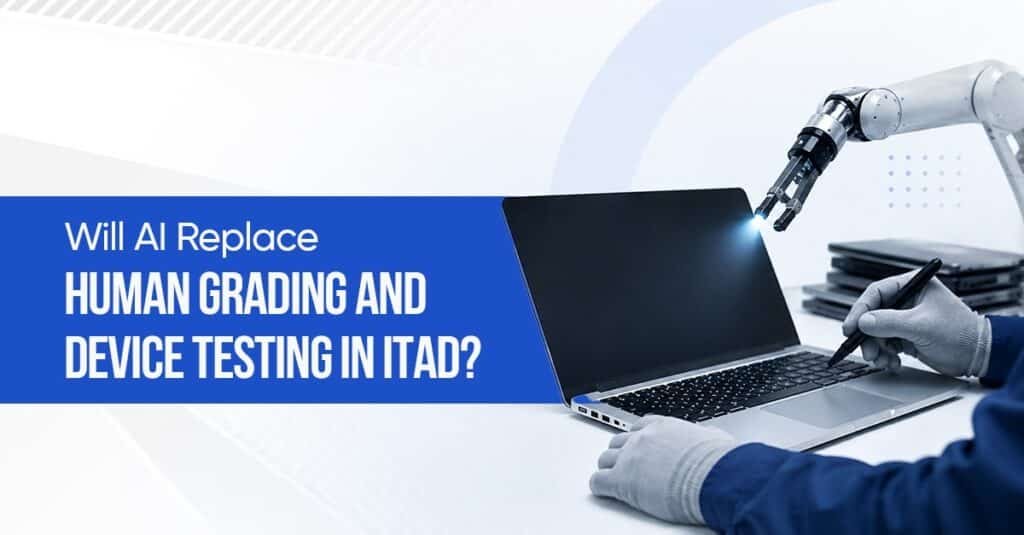
So, will AI replace human grading and device testing?
I don’t believe so.
But it will redefine where people create the most value.
The businesses that lead the next generation of ITAD won’t be those choosing between people and AI.
They’ll be the ones combining experienced teams, connected systems, and digital authority to build organisations that are not only operationally excellent, but impossible to overlook.
At Retentia Eco Impact, these are the conversations we’re increasingly having with ITAD and circular economy businesses as they navigate the next phase of industry growth.
I’d be interested to hear how others in the industry see AI, automation, and connected systems shaping the future of ITAD.
Originally published by Praveena Sasidharan, Founder of Retentia Group, on LinkedIn. You can read the original article here