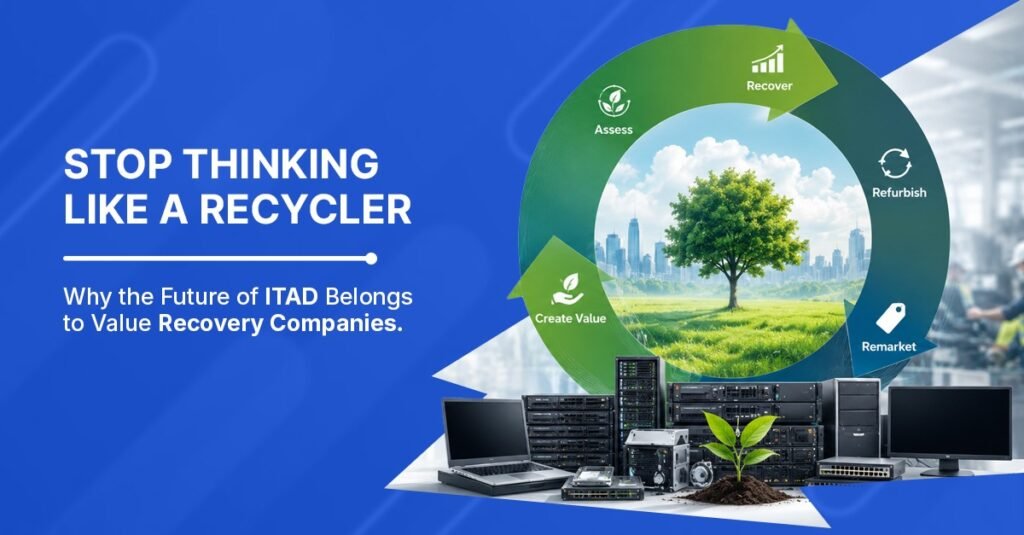
The ITAD industry has a major positioning problem.
Many providers have invested heavily in serialisation tracking, software data erasure, global remarketing networks and workflow automation. Yet much of the industry’s marketing still revolves around trucks, pallets and industrial shredders.
The market’s expectations have evolved.
As the ITAD market continues to expand globally, enterprise buyers are no longer looking for a vendor to simply haul away and destroy retired hardware. They are comparing providers based on business outcomes: capital recovery, risk reduction, audit-ready ESG reporting and data asset intelligence.
If you continue marketing your business as a commodity recycler, you will continue to be compared strictly on disposal costs.
Here is why the future of ITAD belongs to Value Recovery Companies:
Why the Future of ITAD Belongs to Value Recovery Companies
For too long, the IT Asset Disposition (ITAD) industry has described itself in narrow, industrial terms: Collect the equipment, wipe the data, recycle what remains, issue a disposal certificate and move on.
That model still matters. Secure data sanitisation, compliant disposal and responsible recycling remain fundamental operational baselines. The challenge is that this traditional narrative no longer reflects how enterprise buyers think about retired technology.
Today, laptops, servers, networking equipment, storage arrays, processors and memory modules are not simply electronics waiting to be discarded. They are financial instruments, compliance obligations and core sustainability opportunities.
The centre of gravity in the market is shifting from disposal to Value Recovery.
As that structural shift accelerates, ITAD companies that continue positioning themselves primarily as recyclers risk sounding increasingly commoditised in an enterprise market that has become highly strategic.
The Capital Catalyst: 2026’s Perfect Storm
The pressure on enterprise technology estates has reached a tipping point. The end of standard support for Windows 10 has accelerated a major enterprise refresh cycle, forcing many organisations to reassess device replacement, redeployment and lifecycle management strategies.
Simultaneously, enterprises are navigating two additional pressures. Growing investment in AI infrastructure is accelerating refresh decisions across segments of enterprise technology, increasing the volume of assets entering secondary markets. At the same time, ongoing supply chain volatility and semiconductor constraints continue to place pressure on hardware procurement budgets.
For a CIO, retired assets represent an immediate governance and security challenge. For a sustainability leader, they represent a critical avenue to meet Scope 3 value-chain emission requirements. But for a CFO, they represent something equally vital: recoverable capital.
A room filled with decommissioned laptops or retired server racks is no longer viewed simply as electronic waste. Many retired enterprise assets retain residual value through refurbishment, component harvesting, redeployment or secondary-market remarketing.
A basic recycler sees scrap weight and charges a disposal fee a Value Recovery Partner focuses on maximising residual value and returning recoverable capital back into the technology budget.
Moving Beyond the Shredder: What Enterprises Actually Buy
This is precisely why the language of traditional “recycling” has become too small for what elite ITAD providers actually deliver. While materials reclamation is a vital downstream outcome, leading with the physical shredder often overshadows the broader business value being created.
Modern enterprise buyers are not looking to purchase a logistics or disposal service. They are buying specific business outcomes:

When an ITAD firm realigns its positioning around right-column outcomes, it shifts away from procurement-led price discussions and creates a stronger commercial conversation built around value, governance and measurable business impact.
The Six Pillars of the Value Recovery Framework
True Value Recovery is an integrated technology ecosystem. To capture enterprise market share, a provider’s positioning must clearly demonstrate maturity across six distinct operational pillars:
- Asset Remarketing: Maximising secondary market resale value for whole, functional units.
- Component Harvesting: Extracting high-value processors, chipsets and enterprise memory modules from obsolete systems.
- Certified Data Erasure: Utilising software-defined sanitisation (such as Blancco or specialised platforms) to preserve a device’s physical integrity for reuse rather than destroying it.
- Lifecycle Intelligence: Providing data-driven insights into predictive asset lifespans, utilisation and deployment schedules.
- ESG Reporting: Providing serialised carbon tracking and sustainability reporting data that supports regulatory compliance, corporate ESG objectives and stakeholder transparency.
- Capital Return: Executing transparent, market-aware revenue-sharing programs that inject cash back into corporate technology budgets.
The Future of the Category is Tech-Led, Not Truck-Led
If you want a glimpse into the future of the industry, look beyond the warehouse floor. Look at the software.
Leading ITAD providers are investing heavily in automated API integrations with corporate ITAM systems, automated chain-of-custody documentation and real-time valuation dashboards. They are scaling up programmatic sanitisation workflows because they recognise that the modern enterprise demands digital visibility.
In every meaningful respect, the future ITAD provider will look as much like a technology company as a recycling company.
This creates a critical commercial challenge for industry CEOs.
Many ITAD providers have evolved significantly behind the scenes. Operationally, they are highly sophisticated. Yet strategically, their marketing remains stuck in the past, leading with photos of pallets, boxes and freight trucks.
When you market your business like a recycler, the market treats you like a vendor. But when you lead with capital recovery, lifecycle intelligence and risk mitigation, the discussion shifts from warehouse managers to CIOs, CFOs, Chief Sustainability Officers and other executive stakeholders.
The greatest opportunity in ITAD today is not operational innovation. Much of that innovation has already happened.
The opportunity lies in how providers position, communicate and commercialise those capabilities in a market that increasingly values intelligence, transparency, governance and financial return.
The next generation of ITAD leaders will not be defined by how many tons of scrap metal they process. They will be defined by how much corporate risk they remove, how much capital they recover and how effectively they secure the modern technology lifecycle.
The providers that recognise this shift early will not simply participate in the future of ITAD. They will help define it.
Find Where You’re Losing High-Value Opportunities
The gap between operational capability and market perception is often where enterprise opportunities are won and lost.
Many ITAD providers have evolved into sophisticated technology businesses, but their websites, messaging and digital presence still position them as traditional recyclers.
Discover how strategic positioning, SEO and digital marketing built specifically for the ITAD industry can help your business attract enterprise buyers, strengthen market credibility and compete on value rather than price.
Explore Our ITAD Digital Marketing Services →