
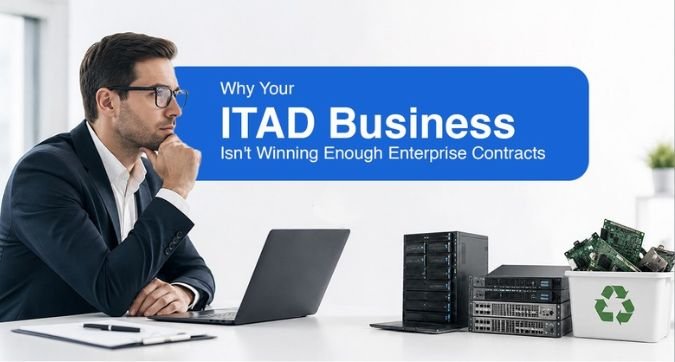
Your ITAD business may be capable of handling enterprise accounts, but that doesn’t necessarily mean enterprise buyers see you that way.
You may have secure data destruction, asset tracking, remarketing, recycling, logistics and compliance processes in place. You may even have years of experience handling large volumes of retired technology. Yet when an enterprise starts comparing providers, your company may not make the shortlist.
The problem may be less about what you can deliver and more about what buyers can discover, understand and verify about your business before they contact you.
Enterprise ITAD procurement rarely begins with “find an ITAD company.” The process often starts much earlier, with questions around data sanitisation, asset recovery, chain of custody, compliance, sustainability and the operational complexity of disposing of technology at scale.
If your website only tells buyers what services you offer, you are missing a large part of that journey.
The ITAD Website Problem: Service List vs. Buying Decision
Consider two ITAD landing pages.
The first says:
Enterprise IT Asset Disposition Services
Secure IT asset disposal, data destruction, recycling and remarketing.
Contact us for a quote.
There is nothing technically wrong with it. But an enterprise buyer still doesn’t know much about the provider’s ability to manage a complex programme.
Now consider a page built around an actual enterprise requirement:
Secure IT Asset Disposition for Multi-Location Technology Refreshes
Retiring 5,000 laptops across 20 locations involves more than collection. Our process maintains asset-level tracking from collection through data sanitisation, remarketing or responsible recycling, with documented chain of custody and reporting throughout the programme.
The second page immediately gives the buyer more to evaluate. It speaks to scale, complexity, process, security and visibility rather than simply listing services.
That difference matters because enterprise buyers aren’t looking for a catalogue of ITAD business services. They are trying to determine whether a provider can safely and reliably manage their particular requirements.
Your landing pages should therefore answer questions such as:
- How are assets tracked?
- How is chain of custody maintained?
- How is data sanitisation verified?
- What happens to assets after processing?
- How is recovered value reported?
- What documentation does the customer receive?
- Can the provider manage multiple locations and large volumes?
The more clearly your website answers these questions, the less work the buyer has to do to establish your credibility.
Enterprise Buyers Research the Problem Before They Research You
This is where many ITAD companies underestimate the role of SEO.
A security professional may not initially search for an ITAD provider. They may search for NIST SP 800-88 data sanitisation requirements because their organisation is reviewing its media disposal process.
An IT operations team might search for enterprise IT asset disposition best practices while planning a hardware refresh.
A procurement team might investigate how to maximise value from retired IT equipment before evaluating remarketing providers.
A sustainability team may research responsible electronics recycling and IT asset disposition as part of its environmental reporting requirements.
These searches have something in common: the buyer is looking for an answer before looking for a supplier.
This is the opportunity.
An ITAD company that publishes authoritative content around these questions can become visible much earlier in the buying journey. The content isn’t simply there to generate an immediate enquiry. It establishes expertise at the point when the buyer is forming an understanding of the problem.
This is also where AEO and GEO become increasingly relevant. When users ask detailed questions through Google, AI search experiences or generative platforms, concise, authoritative answers are more likely to become part of the information they encounter.
For an ITAD business, that means building content around real questions rather than producing articles simply because they contain the phrase “ITAD services.”
A useful guide to NIST SP 800-88, for example, can attract a security-focused audience. A detailed explanation of ITAD chain of custody can reach IT and compliance teams. A practical guide to IT asset remarketing can introduce your expertise to procurement and finance stakeholders.
The goal is to build topical authority around the issues that lead organisations to need ITAD in the first place.
Your Enterprise Proposition Needs More Than “Secure, Compliant and Sustainable”
Most ITAD providers can make similar claims.
Secure.
Compliant.
Sustainable.
End-to-end.
The problem isn’t that these statements are wrong. It’s that they don’t differentiate your business unless you demonstrate what they actually mean in practice.
Take data destruction.
“Secure data destruction” is a service claim.
A stronger proposition might explain that every data-bearing asset is tracked through the disposition process, processed according to the applicable sanitisation requirements, and supported by documentation that gives the customer evidence of completion.
The same principle applies to asset recovery.
“Remarketing services” tells the buyer what you do.
A stronger proposition explains how assets are assessed, valued, channelled into appropriate resale markets and reported back to the customer, with recovered value helping offset the cost of technology refresh programmes.
The distinction is important:
A service describes what you do. A business outcome explains why the customer should care.
Enterprise buyers need both.
Proof Is What Turns Capability Into Confidence
This is where many otherwise capable ITAD businesses leave money on the table.
A website may claim to handle enterprise volumes, but where is the evidence?
A provider may say it offers secure chain-of-custody management, but can a buyer understand how that process works?
A company may promote sustainability, but can it demonstrate what happens to assets that cannot be remarketed?
This is why enterprise-focused ITAD marketing needs evidence alongside claims.
A strong case study, for example, shouldn’t simply say:
“We processed 10,000 devices for a global customer.”
It should explain the challenge: perhaps the organisation was replacing thousands of devices across multiple locations and needed secure collection, data sanitisation, asset tracking and value recovery without disrupting operations.
Then show how the programme was managed and what resulted from it.
That could include processing volume, turnaround time, percentage of assets remarketed, value recovered, data destruction documentation or environmental reporting, where those figures can be disclosed.
Suddenly, the buyer isn’t reading a marketing claim. They’re seeing evidence of how the provider operates.
For enterprise contracts, that distinction can be decisive because the perceived risk of choosing the wrong provider is much higher.
Don’t Wait for the RFP to Start Selling
By the time an enterprise RFP reaches your sales team, the buyer may already know which providers they consider credible.
They have researched the problem, reviewed potential approaches, searched for suppliers, looked at credentials and compared companies.
If your first meaningful interaction with that buyer happens when you submit a proposal, you’re competing at the end of a journey you didn’t influence.
Your marketing should begin much earlier.
Your website should explain complex ITAD requirements. Your content should answer research questions. Your case studies should demonstrate execution. Your service pages should connect capabilities with business outcomes. Your search strategy should make that expertise discoverable across traditional search and AI-powered discovery.
This doesn’t mean turning every page into a sales pitch.
In fact, the opposite is often more effective.
A buyer researching data sanitisation doesn’t necessarily want to read “Contact us today for ITAD services.” They want a credible explanation of what they need to know.
Give them the answer first. Give them a reason to trust the source. The commercial conversation can follow.
The Real Enterprise ITAD Marketing Question
If your ITAD business isn’t winning enough enterprise contracts, the first question shouldn’t necessarily be, “How do we generate more leads?”
Ask a more fundamental question:
When an enterprise buyer starts researching the problem we solve, do they encounter our expertise?
If they do, what happens next?
- Can they understand your capabilities?
- Can they see evidence?
- Can they determine whether you can manage their scale and complexity?
- Can they distinguish your approach from the other ITAD providers appearing in their search?
If the answer to those questions isn’t clear, increasing sales activity may only push more prospects into the same gap.
Enterprise ITAD growth requires more than operational capability. It requires market visibility, relevant expertise and credible proof working together.
The ITAD businesses best positioned to win enterprise contracts will not simply be the ones with the longest list of services. They will be the ones that become visible when buyers are researching the problem, demonstrate that they understand the complexity, and provide enough evidence to make the next step feel low-risk.
The enterprise buying process starts long before the RFP. Your ITAD business needs to be there when the research begins.
Your ITAD Capability Should Be Opening More Enterprise Opportunities
If your operational capability is strong but you’re not winning enough enterprise business, the gap may be in how early your business enters the buying process and how clearly your value is communicated.
Retentia Eco Impact helps ITAD and circular economy businesses strengthen their enterprise visibility, differentiate beyond price, engage buyers earlier and build a more predictable path to growth.